Summer has always been a season of contradictions for parents. Children want to run, jump, cycle, and play outside for hours. The same heat that fuels their energy often leaves them drenched, cranky, and uncomfortable by midday. For decades, the solution was simple and limited: light colours, loose cotton, and a lot of hoping for the best. 2026 has quietly rewritten the rules for children’s summer wardrobes. A new generation of cooling fabrics has moved from niche sportswear labs into kids’ wardrobes, and the shift is bigger than a passing trend. It reflects how parents think about comfort, health, and practicality in a warming world.
Why Ordinary Fabrics Are No Longer Enough
Traditional summer clothing for kids relied entirely on cotton because it breathes and feels soft against sensitive skin. That reputation is well earned. Cotton has real limitations. It absorbs sweat rather than moving it away from the body, which means a child can end up wearing a damp shirt for hours after a burst of outdoor play. Damp fabric clinging to skin is not just uncomfortable; it can also lead to chafing, heat rashes and a higher risk of catching a chill once the child stops moving and the sweat cools.
At the same time, summers themselves have changed. Many regions are recording heatwaves and higher average temperatures than they did even ten years ago. Parents are no longer just picking clothes for an afternoon at the park; they are dressing children for genuinely extreme heat, sometimes for entire school terms. This shift in climate reality has pushed both parents and manufacturers to look beyond cotton and toward fabrics engineered specifically to manage heat and moisture.
What Makes a Fabric “Cooling”
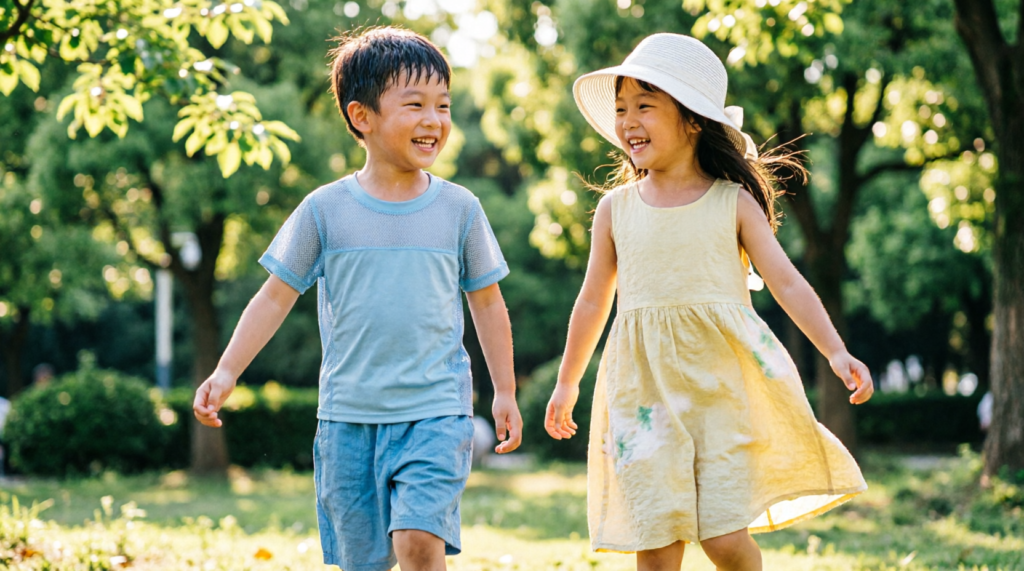
The term “cooling fabric” covers a few technologies, and it helps to understand what is actually happening at the fiber level rather than treating it as a marketing buzzword.
The first category is moisture-wicking fabric. These are usually fine synthetic or semi-synthetic blends engineered with a structure that pulls sweat away from the skin and spreads it across the outer surface of the garment, where it evaporates faster. The child feels drier because the moisture isn’t sitting against the skin; it is being released into the air.
The second category involves fabrics with a cooling sensation on contact. Certain treated fibres and some natural ones have a slightly lower thermal conductivity that creates a faint immediate coolness when the fabric first touches the skin, similar to touching a metal surface versus a wooden one on a hot day. This effect fades after a minute but can make a real difference during the moments a child changes clothes or first steps outside.
The third category is about ventilation and structure rather than the fiber itself. Fabrics. Knitted with tiny gaps, mesh panels, or looser weaves allow air to pass through the garment more freely. Combined with a moisture-wicking base layer, this structural approach can outperform the most advanced synthetic fiber on its own.
Finally, there are fabrics with light-coloured surface treatments designed to bounce back solar radiation rather than absorb it, reducing how much heat actually reaches the fabric surface in direct sunlight.
Most modern kids’ wear labelled as “cooling” in 2026 combines two or three of these approaches rather than relying on just one, which is part of why the newer garments feel noticeably different from the plain cotton t-shirts of a decade ago.
The Materials Leading the Shift
A handful of materials have become the backbone of this movement in children’s fashion.
Bamboo-derived fabric has grown enormously in popularity for kids’ wear because it combines softness with genuinely good moisture management. It tends to be gentle on skin, which matters enormously for parents of children prone to eczema or allergic reactions, and it has a smooth, almost silky feel that many children prefer over the slightly rougher texture of heavier cotton weaves.
Modal and lyocell, both derived from wood pulp through sustainable processing methods rather than older synthetic fibres, have also found their way into children’s summer lines. These fabrics drape, resist wrinkling, and manage moisture better than plain cotton while still feeling natural rather than plasticky.
Technical polyester and nylon blends, once associated with adult activewear, have been reformulated for kids with softer finishes and gentler textures. Brands have worked hard to shed the ” stiff” reputation these fabrics used to have, and the newer versions used in casual kids’ wear feel closer to a soft cotton blend than old-school athletic gear.
Linen has also seen a resurgence, particularly in warmer, drier climates. It is one of the cooling fabrics in human history, valued for its loose weave and breathability, and modern treatments have solved its old problem of wrinkling too easily, making it more practical for active children.
Why Parents Are Paying Attention
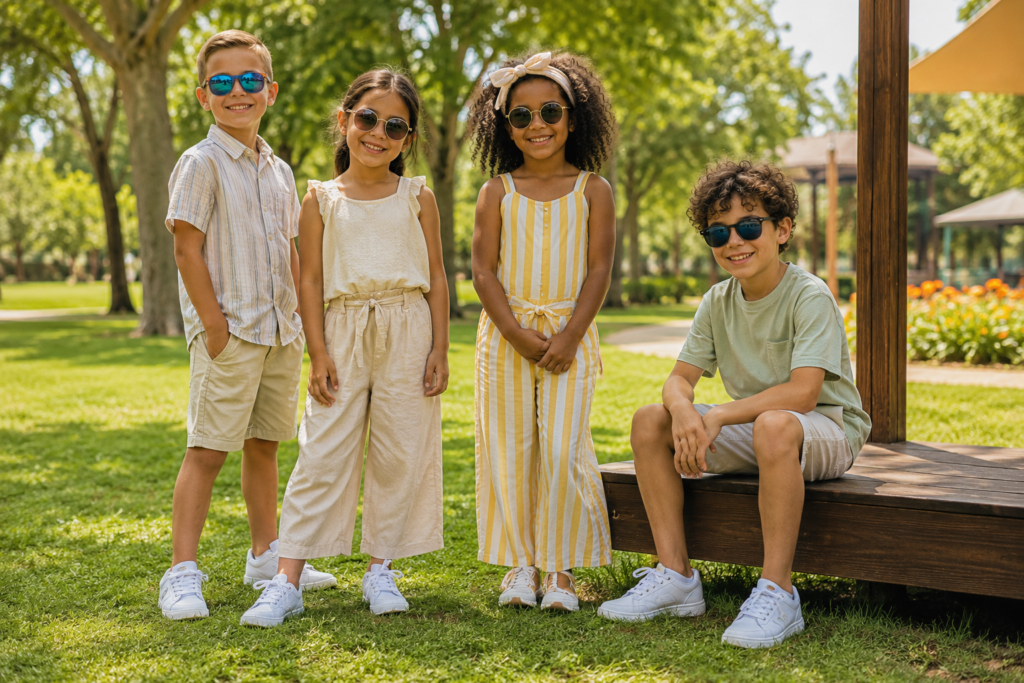
For families, the appeal of cooling fabrics is not abstract. It shows up in concrete daily situations. A child who used to come from school with a soaked, uncomfortable shirt now stays noticeably drier through the same activities. A toddler prone to heat rash during summer months experiences flare-ups when dressed in a well-designed moisture-wicking fabric. A child playing sports in peak afternoon heat can stay active longer without overheating quickly.
There is also a growing awareness among parents about heat-related health risks for children specifically. Kids regulate body temperature more efficiently than adults because their sweat glands are still developing and their surface-area-to-body-mass ratio is higher, meaning they absorb heat from the environment faster relative to their size. This makes clothing more than a comfort choice; it becomes a small but meaningful layer of protection during extreme heat.
Practicality plays a role too. Many of these fabrics are more resistant to odour build-up, which matters for parents managing laundry for active, sweaty children. Faster drying times after washing are another appreciated benefit, especially for families without easy access to a dryer or those living in humid climates where laundry can take a long time to dry naturally.
The Design Side of the Trend
Function alone rarely sells clothing to children, who care as much about how something looks and feels as how well it performs. Kids’ wear brands in 2026 have clearly understood this, moving away from the purely technical look that once defined performance fabrics.
Prints and colours have become a focus. Cooling fabrics now appear in patterns, bright colour-blocking and designs that mimic the same cartoon characters, textures and styles children already gravitate toward in regular clothing. The technical fabric is essentially hidden inside a design children would choose anyway, which removes the friction of trying to convince a child to wear something that “looks different” from their friends’ clothes.
Layering and versatility have also shaped design choices. Lightweight cooling hoodies, breathable joggers and mesh-panelled dresses allow children to move between shaded spaces and bright outdoor play without needing a full outfit change. Adjustable fit silhouettes have become more common too, both because they allow better airflow and because they accommodate the fast growth spurts common in young children, giving garments a slightly longer usable life.
Sun protection has increasingly been built directly into these fabrics as well. Many cooling garments for kids now carry a UPF rating, meaning the fabric itself blocks a percentage of ultraviolet radiation. This pairs the cooling benefit with a sun-safety benefit in a piece of clothing, which is particularly valuable for very young children with delicate skin.
Sustainability Enters the Conversation
As demand for cooling fabrics has grown, so has scrutiny of how they’re produced. Parents increasingly ask not just whether a fabric keeps their child cool. How it was made and what happens to it after it’s outgrown.
This has pushed kids’ wear brands toward more responsibly sourced bamboo and wood-pulp fibres, processed using closed-loop systems that reuse water and chemicals rather than releasing them into the environment. Recycled polyester, made from repurposed plastic bottles and industrial waste, has become another ingredient in cooling blends, offering the performance benefits of synthetic fibre with a somewhat lower environmental footprint than virgin plastic-based fabric.
Durability has also become part of the sustainability conversation. A made cooling garment that survives several summers and gets passed down to a younger sibling ultimately has a smaller environmental impact than a cheaper garment that wears out or loses its cooling properties after a handful of washes. This has encouraged some brands to focus on higher-quality pieces rather than large fast-fashion-style collections for children.
Challenges Still Facing the Category
Despite the momentum, cooling kid wear is not without its complications. Price remains a barrier for many families since garments made with specialty fibres or advanced weaves often cost more than standard cotton basics. This has led to a gap between families who can access premium cooling wardrobes for their children and those who cannot, raising fair questions about whether these benefits should be more widely and affordably available.
There is also the matter of children’s skin sensitivity. Not every synthetic or treated fabric agrees with every child, and some kids react to finishes or blends with irritation even when the fabric is marketed as gentle. This means trial and error is often still necessary, and parents of children with known skin sensitivities are wise to test fabrics in small amounts before committing to a full wardrobe change.
Finally, some experts caution against over-marketing. Not every product labelled “cooling” delivers different performance from a well-made breathable cotton garment. As the category grows, distinguishing engineered cooling fabric from clothing that simply borrows the language of the trend has become an important skill for parents to develop.
Looking Ahead
The rise of cooling fabrics in kids’ clothing shows something more than just a fashion moment. It shows that the fashion industry is reacting to a change in the weather, with more understanding of what kids need physically and parents who don’t want to choose between comfort, safety, and style. As scientists keep working on types of fibres and as green ways to make clothes get better, it is expected that cooling features will be something people expect in kids’ summer clothes instead of something special.
Now the change is already happening on store shelves and online shops in 2026. Kids’ summer clothes are being made from the inside out with comfort, health, and daily use guiding what parents buy. What began as an idea taken from adult sports clothes has turned into one of the most important parts of how a new group of kids dresses during the hottest days of the year.